
Introduction:
I have been studying quantum physics for years now. The universe works in ways that honestly blows my mind every single day, I want to share this amazing journey with you. Here in this article quantum physics explained for beginners. You doesn’t have to worry. I will show you how fascinating this field really are.
You ever wonder why atoms don’t just collapse? This is where our adventure begins today
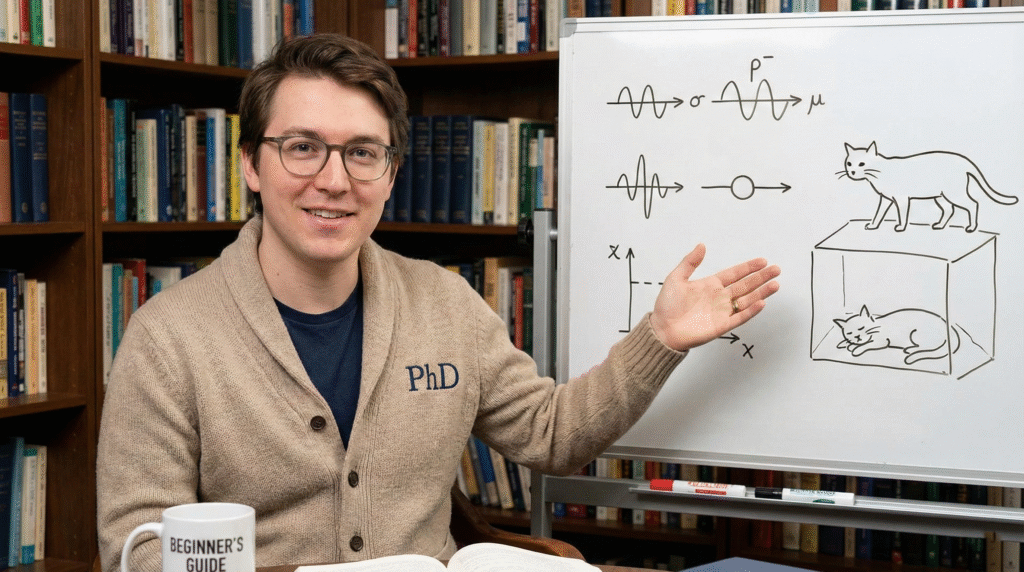
What Exactly Is Quantum Physics?
Quantum physics are the study of really, really tiny things. I am talking about particles so small that you can’t see them even with the most powerful microscope! These particles include electrons, photons, and quarks they’re the building blocks of everything around us.
When I first learned about quantum mechanics, my professor said something that stuck with me forever: “Reality at the quantum level refuses to follow the rules we see in everyday life.” And boy, was he right about that one.
The word “quantum” comes from Latin, meaning “how much.” It refers to the smallest possible amount of any physical property. Energy, for instance, comes in tiny packets called quanta (that’s the plural form).
The Birth of Quantum Theory
Let me take you back to 1900. A German physicist named Max Planck were trying to solve a problem about how hot objects glow, and he accidentally discovered something revolutionary. He found that energy doesn’t flow continuously like water from a tap instead, it come in discrete chunks.
This discovery literally changed everything we thought we knew about physics.
Planck himself didn’t even believe his own discovery at first. Can you imagine that? The father of quantum physics was skeptical of quantum physics! But the mathematics worked too perfectly to ignore, which brings us to one of the most important concepts I’ll teach you today.
The Quantum World: Where Weirdness Becomes Normal
I need you to forget everything you think you know about how objects behave. In the quantum realm, particles can be in two places at once—I know it sounds impossible, but stay with me here.
Wave-Particle Duality Explained Simply
Here’s something that used to keep me up at night when I was studying: light acts like both a wave AND a particle. Sometimes it behaves like ripples in a pond, other times it acts like tiny bullets shooting through space.
This phenomenon are called wave-particle duality, and it’s one of the cornerstone concepts in quantum physics explained for beginners.
Think about it like this. Imagine you had a friend who sometimes acts like a cat and sometimes like a dog not metaphorically, but literally changing forms. That’s essentially what photons (light particles) does.
The famous double-slit experiment demonstrates this beautifully, which I’ll explain in detail shortly.
The Double-Slit Experiment: Mind-Blowing Evidence
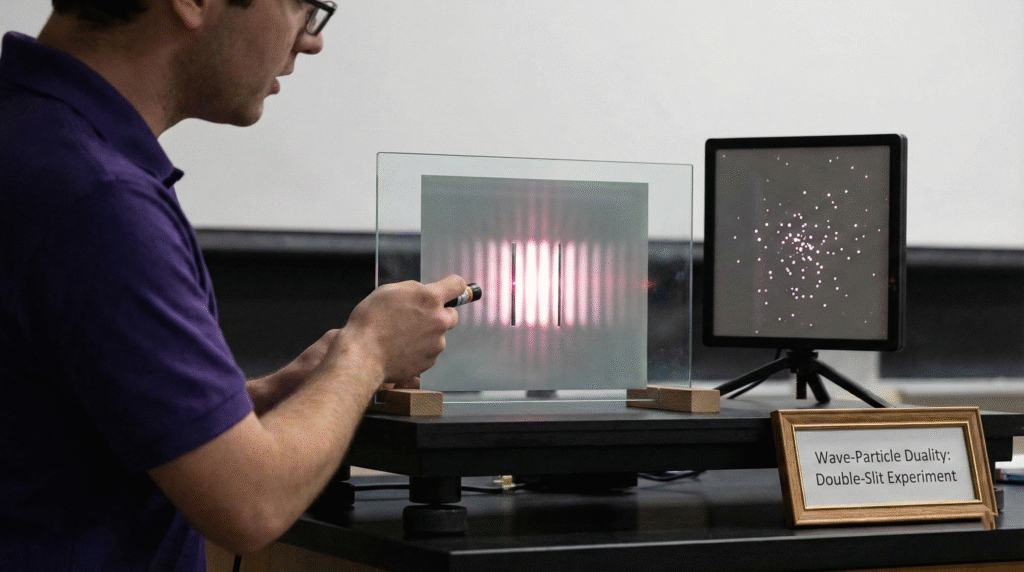
I want you to picture a wall with two narrow slits in it. When we shoot electrons through these slits one at a time, something weird happens even though only one electron passes through at a time, they create an interference pattern on the screen behind the wall.
An interference pattern is what waves make when they overlap. So each individual electron must somehow be going through both slits simultaneously, interfering with itself.
This blew scientists’ minds in the early 1900s. It still blows my mind today, honestly.
But here is where it gets even stranger: if we try to observe which slit the electron goes through, the interference pattern disappears completely. The electron “knows” we’re watching and behaves differently. This brings us to the observer effect, which has philosophical implications that reaches far beyond physics.
Core Principles That Make Quantum Physics Work
Let me break down the fundamental principles that governs the quantum world. I promise to keep things simple, even though these concepts literally reshape how we understand reality itself.
Quantization: Everything Comes in Packets
Energy levels in atoms isn’t continuous but they are quantized. An electron orbiting an atomic nucleus can only exist at specific energy levels, never between them.
I like to think of it like climbing stairs. You can stand on step one or step two, but you can’t float halfway between steps, right? That’s exactly how electrons behaves in atoms.
When an electron jumps from one energy level to another, it either absorbs or emits a photon of light. The color of that light depends on the energy difference between levels—this is why different elements glows different colors when heated.
Superposition: Being Everywhere at Once
This principle states that a quantum particle exists in all possible states simultaneously until someone measures it. I know that sounds like science fiction, but it’s real.
The famous Schrödinger’s cat thought experiment illustrates this concept. Imagine a cat in a sealed box with a device that has a 50% chance of killing it—until you open the box, the cat are supposedly both alive AND dead at the same time.
Now, obviously we don’t think macroscopic cats actually exist in superposition. But quantum particles definitely does! Every unmeasured electron exists in a superposition of all possible positions and momenta simultaneously.
This has been proven experimentally thousands of times. The math works, the experiments confirms it, and yet it still feels impossible to our human brains.
Uncertainty Principle: The Universe Has Limits
Werner Heisenberg discovered something profound in 1927: you cannot simultaneously know both the exact position and exact momentum of a particle. The more precisely you measure one, the less precisely you can know the other.
This isn’t because our measurement tools are imperfect. It’s a fundamental property of nature itself—the universe simply doesn’t allow certain information to coexist precisely.
I remember when my advisor explained this to me: “The universe isn’t playing hard to get,” she said. “This information literally doesn’t exist until we force the universe to choose.”
The mathematical relationship is ΔxΔp ≥ ℏ/2, where Δx is uncertainty in position, Δp is uncertainty in momentum, and ℏ is the reduced Planck constant.
What this means practically? If you try to pin down exactly where an electron is, its momentum becomes completely uncertain, it could be moving at virtually any speed. Conversely, if you measure its momentum precisely, its position becomes spread out across space.
Entanglement: Spooky Action at a Distance
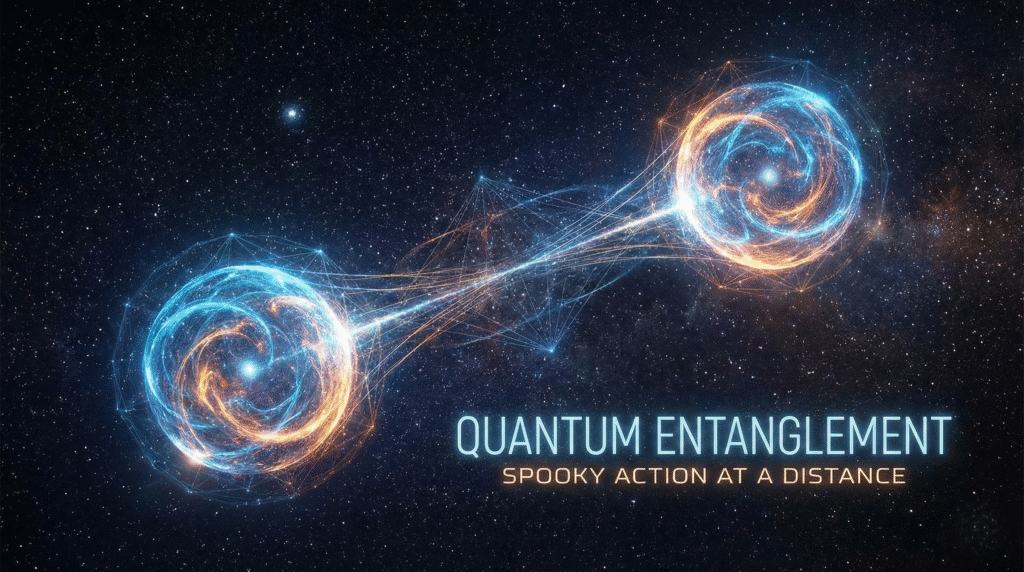
Einstein called this “spooky action at a distance,” and he didn’t like it one bit. Quantum entanglement occurs when two particles becomes correlated in such a way that measuring one instantly affects the other—even if they’re on opposite sides of the universe.
Let me give you an example I use when teaching. Imagine you has two magic coins that are entangled, when you flip one and it lands on heads, the other coin instantly lands on tails no matter how far apart they are.
Now, that’s not exactly how quantum entanglement works, but it captures the essence of the phenomenon.
The really weird part? The first particle doesn’t “decide” its state until you measure it, yet somehow the second particle instantaneously “knows” what result to show! This happens faster than light could travel between them, which bothered Einstein tremendously because it seemed to violate relativity.
However, entanglement has been proven experimentally beyond any doubt. In 2022, the Nobel Prize in Physics were awarded to scientists who demonstrated quantum entanglement conclusively.
The Mathematics Behind Quantum Physics (Simplified)
I won’t lie to you—the full mathematics of quantum mechanics involves complex calculus and linear algebra. But I can give you the essential ideas without drowning you in equations.
The Wave Function: Probability Rules Everything
In quantum mechanics, we describes particles using something called a wave function (represented by the Greek letter psi: Ψ). This mathematical function doesn’t tell us where a particle IS—instead, it tells us where the particle might be found if we look!
The wave function contains all possible information about a quantum system. When we square it (mathematically), we gets the probability of finding the particle at different locations.
This was revolutionary because it means quantum physics are inherently probabilistic. Classical physics says “the ball is here, moving this fast”—quantum physics says “the electron has a 30% chance of being here, 45% chance of being there, and 25% chance of being somewhere else entirely.”
Schrödinger Equation: The Heart of Quantum Mechanics
The Schrödinger equation describes how the wave function changes over time. It’s to quantum mechanics what Newton’s laws are to classical mechanics—absolutely fundamental.
The time-dependent version looks like this: iℏ∂Ψ/∂t = ĤΨ
Don’t worry if that looks scary! The key point is that this equation tells us how quantum systems evolves. Given a wave function at one moment, we can predict how it’ll change—though we still can only predict probabilities, never certainties.
Erwin Schrödinger developed this equation in 1926, and it’s been validated by every quantum experiment since then. The equation works so precisely that we’ve built entire technologies around it.
The Role of Operators in Quantum Mechanics
In quantum physics, physical properties like position, momentum, and energy are represented by mathematical operators. These operators acts on wave functions to extract information.
When you applies an operator to a wave function, you’re essentially asking a question: “What’s the particle’s momentum?” or “What’s its energy?” The operator gives you all possible answers along with their probabilities.
This mathematical framework might seem abstract, but it’s incredibly powerful. Engineers uses these equations to design semiconductors, lasers, and quantum computers.
Real-World Applications: Why Quantum Physics Matters
Quantum physics explained for beginners isn’t just academic, it’s the foundation of modern technology! Let me show you how quantum mechanics affects your daily life in ways you probably never realized.
Semiconductors and Computer Chips
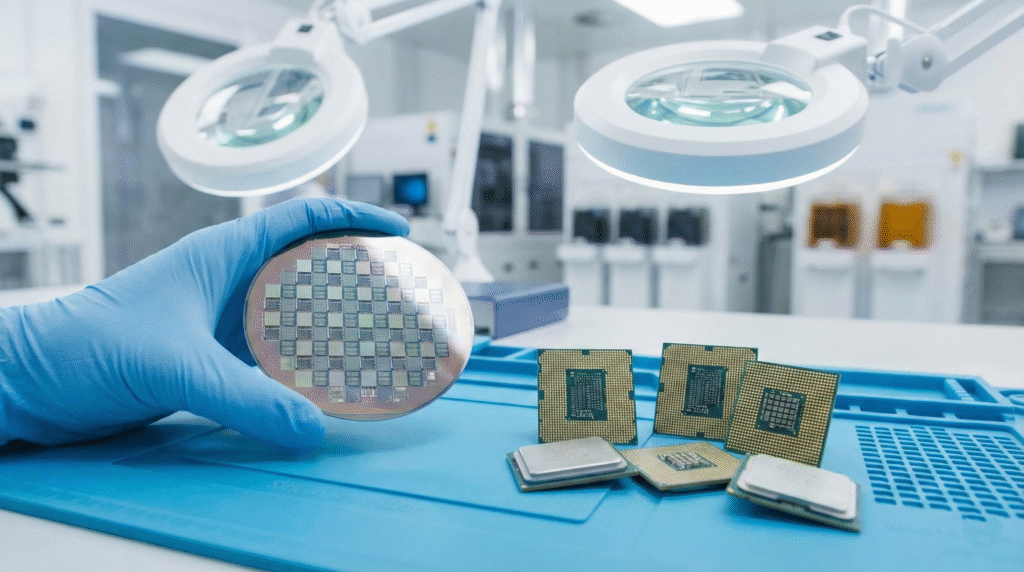
Every electronic device you own—your phone, computer, television—depends entirely on quantum mechanics. Semiconductors works because of quantum properties of electrons in crystalline materials.
When I worked in the semiconductor industry, I was constantly amazed by how we were engineering materials at the quantum level. The chips in modern computers contains transistors just a few nanometres wide, and at that scale, quantum effects dominates everything.
Without understanding quantum tunnelling (where particles can pass through barriers they classically couldn’t), we literally couldn’t design functional transistors at modern sizes.
Lasers: Quantum Light Sources
The laser pointer you use for presentations. That’s quantum physics in action! Lasers work through a process called stimulated emission, which was first predicted by Einstein in 1917.
In a laser, electrons in atoms gets excited to higher energy levels, then they’re stimulated to fall back down simultaneously, emitting light waves that are perfectly synchronized. This is only possible because of quantum mechanics governing how electrons behave in atoms.
I remember building my first laser in graduate school—the moment it worked, I felt like I was wielding quantum magic.
MRI Machines: Quantum Imaging
Magnetic Resonance Imaging uses quantum properties of atomic nuclei to create detailed images of your body’s interior. The hydrogen atoms in your body’s water molecules responds to magnetic fields in ways governed by quantum mechanics.
When doctors looks at an MRI scan, they’re literally seeing quantum physics at work. The signal that creates the image comes from quantum spin states of protons aligning and relaxing.
This technology has saved countless lives by allowing non-invasive imaging of soft tissues, and it only exists because we understands quantum mechanics.

Solar Panels: Harvesting Quantum Energy
Solar panels converts light into electricity through the photovoltaic effect, which is pure quantum physics. When photons hits certain materials, they transfer their energy to electrons, knocking them loose and creating electric current.
The efficiency of solar panels depends critically on quantum mechanical properties of the materials used. Engineers like myself spends countless hours optimizing these quantum properties to capture more sunlight.
As someone who’s worked on solar panel research, I can tell you that every improvement comes from deeper understanding of quantum physics explained for beginners and experts alike.

Advanced Concepts (Made Accessible)
Now that you understands the basics, let me take you deeper into some concepts that usually only gets taught at the graduate level. Don’t worry though—I’ll keep things digestible.
Quantum Tunneling: Walking Through Walls
One of the most counterintuitive quantum phenomena is tunneling. Imagine throwing a ball at a wall classically, if the ball doesn’t have enough energy, it bounces back. But in the quantum world, there’s a probability the ball will spontaneously appear on the other side.
This happens because the wave function doesn’t sharply stop at barriers. Instead, it exponentially decays into the barrier, and if the barrier is thin enough, there’s some wave function on the other side—meaning there’s a probability of finding the particle there.
Quantum tunneling is why the sun shines. Nuclear fusion in the sun’s core requires protons to overcome enormous electrical repulsion and get close enough to fuse. Classically, the sun isn’t hot enough for this—but quantum tunneling allows it to happen anyway.
I find it poetic that our entire existence depends on particles doing something they classically “shouldn’t” be able to do.
Spin: Not What You Think It Is
Quantum particles has a property called “spin,” but they’re not actually spinning like tops! Spin is an intrinsic form of angular momentum that particles possess, and it comes in discrete values.
Electrons, for instance, are spin-1/2 particles. They can have spin “up” or spin “down” relative to any axis you choose to measure. But here’s the weird part: an electron doesn’t have a definite spin direction until you measures it.
Before measurement, the electron exists in a superposition of spin-up and spin-down. The act of measuring forces it to “choose” one or the other.
Spin is crucial for many technologies. The entire field of spintronics—which may revolutionize computing—depends on manipulating electron spin states.
Quantum Field Theory: The Deeper Truth
As you advances in your study of quantum physics, you eventually encounters quantum field theory (QFT). This framework combines quantum mechanics with special relativity and provides our most accurate description of fundamental particles.
In QFT, particles aren’t really particles at all—they’re excitations in underlying quantum fields that permeates all of space! An electron is an excitation in the electron field, a photon is an excitation in the electromagnetic field, and so on.
I know this sounds crazy, but quantum field theory has made predictions accurate to one part in a trillion. It’s the most precisely tested scientific theory in human history.
The mathematics gets extremely complex here, involving path integrals, Feynman diagrams, and renormalization. But the core idea isn’t that hard: reality is made of fields, and particles are just ripples in those fields.
Decoherence: Why We Don’t See Quantum Weirdness Everyday
You might wonder: if quantum mechanics is the fundamental theory, why don’t we see superposition and interference in our daily lives? Why doesn’t your car exist in two places at once?
The answer is decoherence. When quantum systems interacts with their environment (which macroscopic objects constantly does), their quantum properties rapidly disappears. The superposition collapses, interference effects vanishes, and classical behavior emerges.
Decoherence happens incredibly fast for large objects in nanoseconds or less. This is why we don’t observe quantum effects in everyday life, even though quantum mechanics technically applies to everything.
Keeping quantum systems isolated enough to maintain their quantum properties is one of the biggest challenges in building quantum computers. We needs to prevent decoherence long enough to perform calculations.
Quantum Computing: The Future Is Here
I’m particularly excited about quantum computers because they represents the next revolution in information technology. Let me explains how they works and why they’re so powerful.
Qubits vs Classical Bits
Classical computers uses bits that are either 0 or 1. Quantum computers use qubits that can be in a superposition of both 0 AND 1 simultaneously.
This means a quantum computer with just 300 qubits could simultaneously process more states than there is atoms in the observable universe. The potential computational power is staggering.
However, building stable qubits is extremely difficult. They requires near-absolute-zero temperatures and extreme isolation from environmental noise. Despite these challenges, several companies has now built working quantum computers with hundreds of qubits.
Quantum Algorithms: Doing the Impossible
Certain problems that would take classical computers longer than the age of the universe to solve could potentially be solved by quantum computers in hours or days.
Shor’s algorithm, for example, can factor large numbers exponentially faster than the best known classical algorithms. This has huge implications for cryptography, since most encryption relies on the difficulty of factoring large numbers.
Grover’s algorithm provides quadratic speedup for searching unsorted databases. If you have a million items, classical search takes about 500,000 operations on average—Grover’s algorithm does it in about 1,000.
Current State of Quantum Computing
We’re in what many calls the “NISQ era” Noisy Intermediate-Scale Quantum. Current quantum computers has 50-1000 qubits, but they’re noisy (error-prone) and can’t run long calculations before decoherence destroys the quantum state.
Despite these limitations, quantum computers has already achieved “quantum advantage” for certain specific tasks, performing calculations that classical supercomputers can’t verify.
The race is on to build error-corrected, large-scale quantum computers. When we achieves that, it’ll transform chemistry simulation, drug discovery, financial modeling, artificial intelligence, and cryptography.
Interpretations of Quantum Mechanics: What Does It All Mean?
Here’s where things gets philosophical The mathematics of quantum mechanics works perfectly, but what does it actually mean? Physicists has debated this for a century.
The Copenhagen Interpretation
This is the traditional view taught in most textbooks. It says that particles don’t have definite properties until measured—the wave function represents our knowledge, and measurement causes it to collapse to a definite state.
Under this interpretation, the quantum world is fundamentally probabilistic. God does play dice with the universe, contrary to Einstein’s famous objection!
I was taught this interpretation in school, and for practical purposes it works fine. But philosophically, it raises troubling questions about the role of consciousness and observation.
Many-Worlds Interpretation
This interpretation, proposed by Hugh Everett in 1957, says there’s no wave function collapse at all! Instead, every quantum measurement causes the universe to split into multiple branches.
When you measures an electron’s spin, the universe branches into one where you observed spin-up and another where you observed spin-down. Both outcomes happens just in different parallel universes.
This sounds like science fiction, but it’s actually taken seriously by many physicists because it avoids the measurement problem. The math works without requiring any special collapse mechanism.
I find this interpretation both fascinating and disturbing—if it’s true, there are countless versions of me in parallel universes making different choices.
Pilot Wave Theory (de Broglie-Bohm)
This interpretation says particles always have definite positions, guided by a “pilot wave” that evolves according to Schrödinger’s equation. It’s deterministic—randomness only appears because we can’t know the initial conditions precisely enough.
While this interpretation has some appealing features, it requires accepting non-local connections (influences that propagates faster than light), which many physicists finds problematic.
The debate over interpretations continues today, with no consensus in sight. What’s remarkable is that all interpretations makes identical predictions for experiments—they differs only in their metaphysical claims about what’s “really” happening.
Common Misconceptions About Quantum Physics
Let me clears up some widespread misunderstandings about quantum mechanics. I’ve encountered these myths countless times, even among educated people.
Misconception 1: Quantum Physics Means Anything Goes
Some people thinks quantum mechanics means reality is completely subjective or that you can make anything happen by “quantum manifesting.” This is complete nonsense.
Quantum mechanics is extremely precise and mathematical. While it’s probabilistic, those probabilities are exact and predictable. You can’t use quantum physics to justify magical thinking.
The observer effect doesn’t mean consciousness creates reality it means interactions (measurements) affects quantum systems. A particle detector is an “observer,” not necessarily a conscious being.
Misconception 2: Heisenberg’s Uncertainty Principle Is About Measurement Disturbance
Many people believes the uncertainty principle exists because our measurement tools disturbs particles. This is wrong.
The uncertainty is fundamental to nature itself. Even with perfect, non-disturbing measurement tools, we couldn’t simultaneously know position and momentum precisely because that information doesn’t exist in nature.
Misconception 3: Quantum Tunneling Means Particles Travel Through Barriers
When quantum tunneling happens, the particle doesn’t actually travel through the barrier in the classical sense it disappears from one side and appears on the other without ever being inside.
This is because the particle doesn’t have a definite position during the process. Its wave function extends through and beyond the barrier, and there’s a probability of detecting it on the other side.
The language we uses makes this confusing, but that’s because classical language wasn’t designed to describe quantum phenomena.
Experimental Verification: How We Know This Stuff Is Real
You might be thinking: “This all sounds crazy—how do we knows it’s true?” Great question! Let me tell you about some key experiments that has confirmed quantum mechanics beyond any reasonable doubt.
The Stern-Gerlach Experiment (1922)
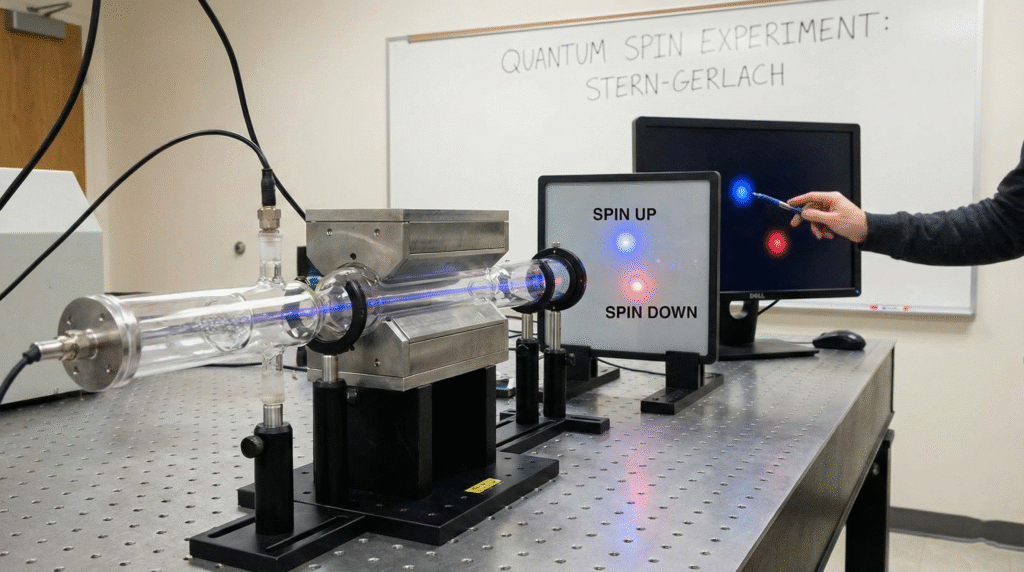
This experiment measured the magnetic properties of silver atoms and discovered quantum spin. When silver atoms passed through a non-uniform magnetic field, they split into exactly two beams not a continuous distribution as classical physics predicts.
This proved that angular momentum (spin) is quantized, taking only discrete values. It was one of the first direct demonstrations of quantum mechanics.
I’ve performed versions of this experiment in teaching labs, and watching those two distinct spots appear never gets old.
Bell Test Experiments: Proving Entanglement Is Real
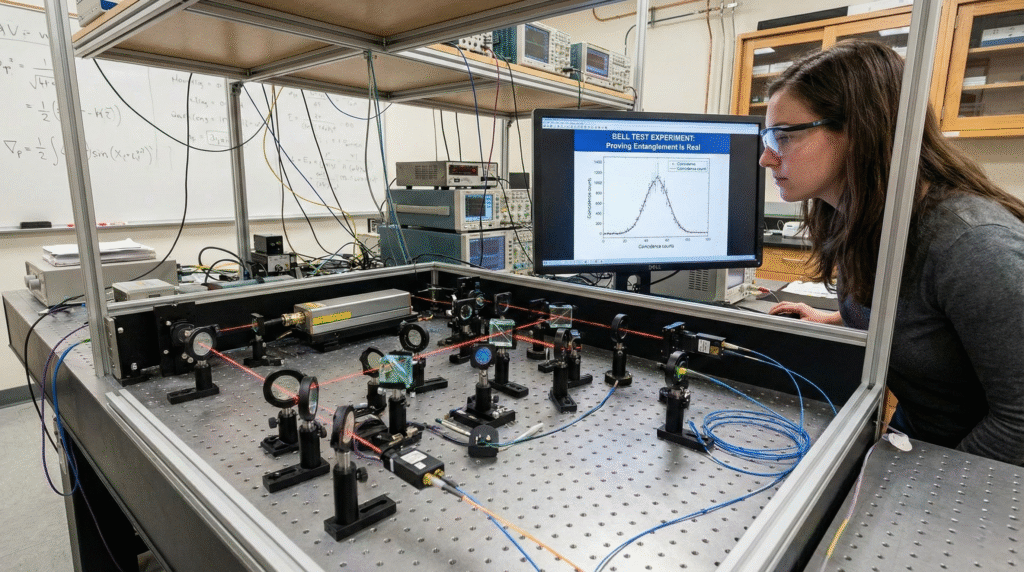
John Bell developed a mathematical test in 1964 that could distinguish between quantum mechanics and local hidden variable theories. Starting in the 1970s, experiments consistently violated Bell’s inequalities, proving quantum entanglement is real.
The most conclusive tests were performed in 2015-2022, closing all potential loopholes. These experiments proves that nature really is non-local—measurements here can instantaneously correlate with measurements far away in ways that no classical theory can explain.
This is arguably the most profound experimental result in physics history. It tells us reality itself is fundamentally different from what our intuition suggests.
Quantum Eraser Experiments
These experiments shows something even weirder than the double-slit experiment: you can retroactively change whether an interference pattern appears by erasing “which-path” information after the particle has already passed through the slits.
It’s as if the present decision affects the past behavior of particles. Of course, that’s not quite what’s happening but the results challenges our basic notions of causality and time.
I’ve studied these experiments extensively, and they never fails to make my brain hurt in the best possible way.
The Quantum Revolution: Where We’re Heading
Quantum physics explained for beginners wouldn’t be complete without discussing where this field is headed. The 21st century may well be remembered as the quantum century.
Quantum Communications
Quantum cryptography uses entanglement to create unbreakable encryption. Any attempt to eavesdrop on a quantum communication channel would disturb the quantum states and be immediately detected.
China has already launched a quantum communication satellite, and quantum networks is being developed worldwide. In the next few decades, quantum-secured communication may become standard for sensitive information.
Quantum Sensing
Quantum sensors can detect gravitational waves, magnetic fields, and other phenomena with unprecedented precision by exploiting quantum superposition and entanglement.
These sensors could revolutionize medical imaging, geological surveying, and fundamental physics research. Some quantum sensors can detect individual photons or measure time to billionths of a billionth of a second.
The applications we hasn’t even imagined yet probably exceeds what we can currently envision.
Quantum Materials
Understanding quantum mechanics at a deeper level is leading to discovery of exotic materials with strange properties: superconductors that conducts electricity without resistance, topological insulators with surfaces that conducts while their interiors doesn’t, and materials with properties that can’t exist classically.
These materials could transform energy transmission, computing, and countless other technologies. We’re only beginning to explore the space of possible quantum materials.
Learning More: Your Journey Continues
If you’ve made it this far, congratulations. You now understands the core concepts of quantum physics better than 99% of people. But this is just the beginning of what you can learn.
Recommended Resources for Deeper Study
For the mathematically inclined, I recommends starting with Griffiths’ “Introduction to Quantum Mechanics“—it’s rigorous but accessible. Feynman’s lectures on physics also covers quantum mechanics beautifully, with minimal math.
If you prefers visual learning, PBS Space Time and Minute Physics has excellent YouTube videos on quantum topics. Don’t underestimate the value of good video explanations.
For philosophy of quantum mechanics, “Quantum Theory and the Schism in Physics” by Karl Popper provides fascinating perspectives, as does “Something Deeply Hidden” by Sean Carroll.
Mathematical Preparation
To truly master quantum physics, you’ll needs calculus (derivatives and integrals), linear algebra (vectors and matrices), and differential equations. These mathematical tools allows you to actually solve quantum mechanical problems rather than just understanding them conceptually.
I know math can seem intimidating, but remember: every physicist who ever lived had to learn this stuff from scratch! With persistence and good resources, you can definitely do it.
The satisfaction of solving your first Schrödinger equation problem is indescribable.
Experimental Experience
If possible, try to get hands-on experience with quantum phenomena. Many universities offers undergraduate research opportunities in quantum labs. Even if you’re not a student, some institutions has public lectures and demonstrations.
There’s something transformative about seeing quantum effects with your own eyes. When I first observed photon anti-bunching in the lab—direct evidence that light is quantized—it made everything click in a way reading never could.
Conclusion: Embracing the Quantum Universe
Quantum physics explained for beginners reveals a universe far stranger and more wonderful than everyday experience suggests. Reality at its deepest level operates on principles that defies classical intuition particles existing in superposition, entanglement connecting distant objects, and uncertainty woven into the fabric of nature itself.
Yet this strange theory works. It’s been tested billions of times in countless experiments, and it never fails. Modern civilization depends on quantum mechanics for everything from smartphones to medical imaging to solar panels.
I hope this guide has sparked your curiosity and given you a foundation to build on. Quantum mechanics is challenging, no doubt about that. But it’s also accessible to anyone willing to put in the effort to understand it properly.
The quantum revolution is accelerating. Quantum computers, quantum communications, and quantum sensors is transforming from laboratory curiosities into practical technologies. Understanding quantum physics isn’t just intellectually rewarding it’s increasingly practical for navigating the modern world.
Remember: every expert was once a beginner. Every physicist who has ever lived started from the same place you’re at now, trying to wrap their head around these bizarre concepts. What matters isn’t where you start, but that you keeps learning and asking questions.
The quantum universe awaits your exploration. Welcome to the journey. it only gets more fascinating from here.
If you want to know how you can explain science to non scintific background people you may like my this article- Tips for Explaining Science to Non-Scientists: A Complete Guide