
Artificial intelligence is no longer limited to tech companies or chatbot systems. It is now deeply integrated into scientific research, particularly in physics. From particle accelerators to astrophysical surveys, machine learning is transforming how physicists analyze data, build models, and simulate complex systems.
This comprehensive pillar guide explains AI for physics students in depth. It explores the mathematical foundations, curve fitting applications, lab data analysis, simulations, real-world scientific datasets, and the strategic roadmap needed to integrate machine learning into modern physics research.
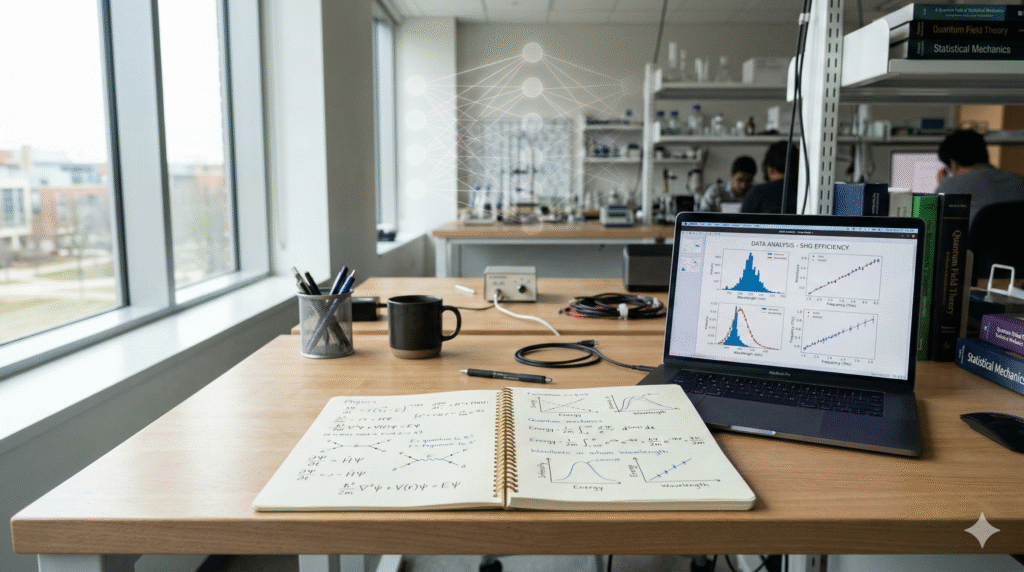
Why AI for Physics Students Is Becoming Essential
Physics has always relied on data. However, modern experiments generate data at unprecedented scale and complexity.
- Particle accelerators produce billions of collision events.
- Space telescopes generate terabytes of astronomical images.
- Quantum experiments record high-resolution time-series measurements.
- Imaging systems produce multidimensional datasets.
Traditional analytical tools remain powerful, but they struggle with nonlinear patterns, high-dimensional data, and computational limits. Machine learning enhances pattern recognition, accelerates computation, and enables predictive modeling beyond classical approaches.
The Mathematical Bridge Between Physics and Machine Learning
Many physics students believe AI is a separate domain. In reality, machine learning is built upon mathematics already familiar to physicists.
Linear Algebra
Quantum mechanics operates in vector spaces. Neural networks operate in vector spaces. Matrix multiplication, eigenvalues, and basis transformations are central to both disciplines.
Optimization
In classical mechanics, systems minimize action. In machine learning, models minimize loss functions using gradient descent.
Loss function example:
Mean Squared Error (MSE):
MSE = (1/N) × Σ (y_actual − y_predicted)2
This is structurally similar to least squares fitting used in experimental physics.
Probability Theory
Statistical mechanics and Bayesian inference both rely on probability distributions. Machine learning extends this idea by modeling uncertainty in predictions.
Bias–Variance Tradeoff
In physics experiments, overfitting noise leads to misleading conclusions. In machine learning, high variance models memorize noise. High bias models oversimplify reality. Understanding this tradeoff is crucial for scientific modeling.
Machine Learning for Curve Fitting in Physics
Curve fitting is one of the most fundamental tasks in experimental physics.
Classical Least Squares Method
We assume a model:
y = f(x; θ)
We minimize:
Σ (y_observed − y_model)2
This works when:
- The functional form is known.
- Noise is approximately Gaussian.
- The dataset is manageable.
Limitations of Classical Fitting
- Nonlinear parameter spaces can be unstable.
- Overlapping spectral peaks are difficult to separate.
- Noise distributions are not always Gaussian.
- Multidimensional datasets complicate optimization.
Machine Learning-Based Curve Fitting
Machine learning allows models to approximate functions without explicitly defining the analytical form.
Advanced approaches include:
- Polynomial regression with regularization
- Support Vector Regression (SVR)
- Gaussian Process Regression (GPR)
- Neural network regression
Gaussian Process Regression in Physics
Gaussian processes are particularly powerful because they provide uncertainty estimation. This is critical in physics experiments where error analysis is essential.
A Gaussian process defines a distribution over possible functions and updates predictions based on observed data.
This allows:
- Confidence intervals for predictions
- Robust interpolation between sparse measurements
- Improved modeling of noisy signals
AI for Data Analysis in Physics Labs
Modern laboratories generate complex, noisy datasets. AI enhances data processing capabilities in several ways.
Denoising Experimental Data
Neural networks can learn to remove structured noise in CCD imaging or spectroscopy data while preserving signal features.
Classification of Detector Events
In particle physics, machine learning models classify collision events into signal and background categories.
Clustering Experimental States
Unsupervised learning methods such as k-means clustering or principal component analysis help identify phase transitions or hidden patterns.
Anomaly Detection
Rare physical events often appear as anomalies. Machine learning can detect statistically significant deviations from normal patterns.
Case Study: Exoplanet Detection Using Machine Learning
NASA provides open exoplanet transit data. When a planet passes in front of a star, brightness decreases slightly.
The challenge:
- Transit dips are small.
- Noise from instrumentation is significant.
- Stellar variability adds complexity.
Machine learning helps by:
- Classifying light curves
- Filtering noise patterns
- Detecting periodic signals
Instead of manually thresholding brightness values, ML models learn complex temporal patterns that indicate planetary presence.
AI for Physics Simulations
Numerical simulations are central to theoretical and computational physics. However, solving differential equations repeatedly is computationally expensive.
Surrogate Modeling
Machine learning models approximate simulation outputs after being trained on simulation data.
Benefits:
- Instant predictions
- Reduced computational load
- Efficient parameter exploration
Physics-Informed Neural Networks (PINNs)
PINNs incorporate governing equations directly into training.
Loss function structure:
Total Loss = Data Loss + Physics Constraint Loss
This ensures predictions obey conservation laws or differential equations.
Applications include:
- Fluid dynamics
- Quantum systems
- Electromagnetic field modeling
- Heat diffusion problems
Common Mistakes Physics Students Make When Using AI
- Overfitting noisy experimental data
- Ignoring physical constraints
- Data leakage between training and testing
- Blind trust in black-box outputs
- Misinterpreting accuracy metrics
Physics intuition must always guide machine learning interpretation.
Practical Roadmap for Physics Students
Step 1: Strengthen Mathematical Foundation
- Linear algebra
- Probability and statistics
- Optimization methods
- Differential equations
Step 2: Learn Scientific Python
- NumPy
- SciPy
- Pandas
- Matplotlib
- Scikit-learn
- PyTorch or TensorFlow
Step 3: Apply ML to Real Lab Data
- Fit oscillation experiments
- Denoise spectroscopy measurements
- Classify diffraction patterns
- Analyze detector time-series signals
Step 4: Work With Real Scientific Datasets
Use NASA open datasets or particle physics repositories to build practical projects.
Advantages of AI in Modern Physics
- Handles large datasets efficiently
- Improves signal detection in noisy environments
- Accelerates computational simulations
- Enhances predictive modeling
- Automates repetitive analysis tasks
Limitations and Responsible Use
AI should complement physics reasoning, not replace it.
Responsible usage requires:
- Proper cross-validation
- Uncertainty estimation
- Interpretability where possible
- Respect for physical constraints
The Future of AI for Physics Students
The future physicist will combine theory, experimentation, and computational intelligence. AI will become as essential as numerical methods and statistical analysis.
Students who learn machine learning early gain an advantage in research, academia, and industry.
Frequently Asked Questions
What is AI for physics students?
It refers to applying machine learning techniques to analyze experimental data, fit models, accelerate simulations, and solve complex scientific problems.
Is machine learning necessary for physics research?
While not mandatory in all areas, it is increasingly important in experimental and computational domains.
Can AI replace theoretical physics?
No. AI enhances computation and pattern recognition but does not replace physical laws or theoretical reasoning.
What is a good starting project?
Exoplanet detection, Gaussian peak fitting in spectroscopy, or classification of particle collision events are strong starting points.
Final Thoughts
AI for physics students is not about following trends. It is about expanding scientific capability. When physical intuition meets machine learning tools, discovery accelerates.
The next generation of physicists will not choose between equations and algorithms. They will master both.